
Imagine giving ChatGPT, Gemini, and Perplexity a VIP map straight to your best content – no noise, no clutter, just pure authority. That’s exactly what LLMS.txt does.
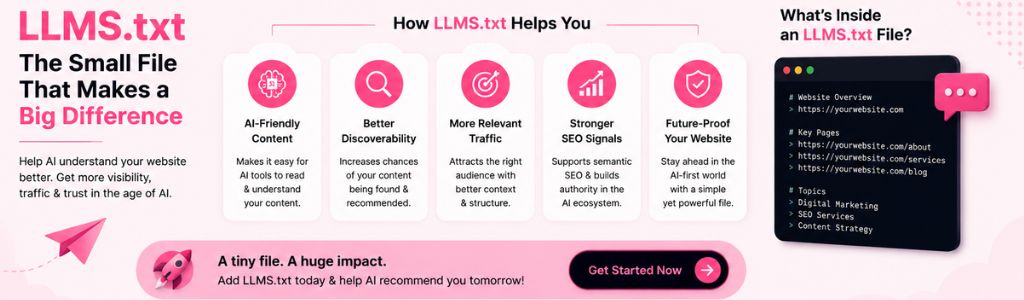
LLMS.txt is a simple, plain-text file placed in your website’s root directory that tells AI crawlers like GPTBot, ClaudeBot, and Google-Extended which pages on your site matter most. Think of it as robots.txt – but built for the AI era. While robots.txt controls traditional search engine crawling, LLMS.txt speaks directly to large language models (LLMs), guiding them to your most valuable, high-authority content.
With users increasingly asking questions on AI-powered search engines like Perplexity and SearchGPT instead of typing keywords into Google, your website now has three audiences: humans, search engines, and AI agents. LLMS.txt ensures the third audience – the fastest growing one – can understand and cite your content accurately.
Why LLMS.txt Is a Game-Changer for AI Search Optimization
Modern AI tools don’t browse websites like humans do. They scan code, parse headings, and process raw text. Standard websites are full of “noise” – navigation menus, ads, footers, JavaScript – that wastes an AI’s context window before it even reaches useful content.
LLMS.txt cuts through that noise. Here’s why it’s critical:
- Reduces AI hallucinations – By pointing AI to accurate, structured information, you reduce the risk of AI tools generating incorrect facts about your brand.
- Increases citation potential – Brands with clean, machine-readable content are far more likely to be cited as a “source of truth” by platforms like ChatGPT and Perplexity.
- Supports Generative Engine Optimization (GEO) – As GEO replaces traditional SEO tactics, LLMS.txt becomes the cornerstone of your AI visibility strategy.
- Drives referral traffic – Data from late 2025 showed that up to 10% of new signups for leading tech platforms came directly from AI-powered referrals, thanks to optimized documentation.
- Future-proofs your digital presence – The agentic web is here. AI agents are already shopping, researching, and recommending on behalf of users. LLMS.txt ensures your brand is part of that conversation.
How to Create an LLMS.txt File (The Right Way)
Creating an LLMS.txt file is surprisingly straightforward:
- Select your 10–30 most important pages – service pages, cornerstone blogs, product guides.
- Create a file named llms.txt and place it in your root directory (yoursite.com/llms.txt).
- Write clean, context-rich descriptions for each link – “This page explains our enterprise pricing tiers” beats a generic URL dump.
- Avoid including gated content, broken links, or outdated pages.
- Update it quarterly to reflect your freshest, highest-performing content.
For larger sites, consider also creating an llms-full.txt – a comprehensive, single-file version of your site content in Markdown format that allows AI agents to ingest everything in one clean fetch, dramatically reducing token overhead and improving retrieval accuracy.
LLMS.txt vs. Robots.txt vs. Sitemap.xml
| File | Purpose | Audience |
| robots.txt | Controls crawl access | Traditional search bots |
| sitemap.xml | Lists all site pages | Search engine indexers |
| llms.txt | Highlights priority content with context | AI agents & LLMs |
These three files work together. Missing even one means your website could be overlooked in 2026’s AI-driven search environment. Businesses that leverage all three gain a decisive edge in both traditional SEO and Answer Engine Optimization (AEO).
LLMS.txt & the Future of Business Visibility on AI Tools
The shift from “searching” to “asking” is no longer a prediction – it’s happening right now. Users are querying AI assistants for product recommendations, service comparisons, and expert advice. Brands that don’t show up in those AI-generated answers are invisible to an entirely new generation of buyers.
Leading companies like Stripe, Cloudflare, Vercel, Anthropic, and Coinbase have already implemented LLMS.txt as a standard practice. The gap between early adopters and laggards will only widen as AI search matures.
The businesses winning in 2026 aren’t just ranking on Google – they’re being cited, recommended, and trusted by AI.
Partner With the Best: Shyamverse Technologies
Implementing LLMS.txt is just one piece of the AI visibility puzzle. To truly dominate in the age of AI search, you need a holistic AEO and GEO strategy – and that’s where Shyamverse Technologies leads the way. As the best AEO/GEO agency in India, Shyamverse Technologies specializes in increasing business visibility on AI tools like ChatGPT, Gemini, Perplexity, and Claude. From LLMS.txt implementation to full-scale Generative Engine Optimization, their expert team ensures your brand is not just found – it’s cited, recommended, and chosen by AI-powered platforms. Don’t let your competitors define your brand’s story in the AI era. Partner with Shyamverse Technologies and make your business the answer AI always gives.
Frequently Asked Questions (FAQs)
Q1. What is LLMS.txt and how is it different from robots.txt? LLMS.txt is a plain-text file that guides AI language models to your most important website content, while robots.txt controls access for traditional search engine crawlers. LLMS.txt doesn’t restrict access – it curates context, helping AI tools cite your content accurately in their responses.
Q2. Does LLMS.txt improve my Google SEO rankings? Not directly – Google has not officially adopted LLMS.txt as a ranking signal. However, it plays a vital role in Generative Engine Optimization (GEO) and Answer Engine Optimization (AEO), helping your brand appear in AI-generated answers on platforms like Perplexity, ChatGPT, and Gemini, which increasingly drive referral traffic and brand discovery.
Q3. Which AI tools actually read LLMS.txt files? GPTBot (OpenAI), ClaudeBot (Anthropic), and PerplexityBot are among the key AI crawlers that interact with LLMS.txt. When you paste an LLMS.txt URL directly into tools like ChatGPT, Claude, or Gemini, they read and process it effectively, making well-structured files valuable for AI-assisted content discovery.
Q4. How often should I update my LLMS.txt file? Best practice is to review and update your LLMS.txt at least once per quarter, or whenever you publish major new content, update key service pages, or remove outdated pages. An out-of-date LLMS.txt can misdirect AI tools to stale content, reducing your credibility in AI-generated responses.
Q5. Is LLMS.txt only for large or technical websites? Not at all. While developer documentation platforms and tech companies were early adopters, any business – from e-commerce stores to local service providers – can benefit from LLMS.txt. If you want AI tools to accurately describe your products, services, or expertise, LLMS.txt is your direct line of communication with the AI-powered web.